
Semaglutide vs Cagrilintide: GLP-1 vs Amylin Analogue Science
For laboratory research only. Not for human or animal use. This article gives no dosing, administration or therapeutic advice.
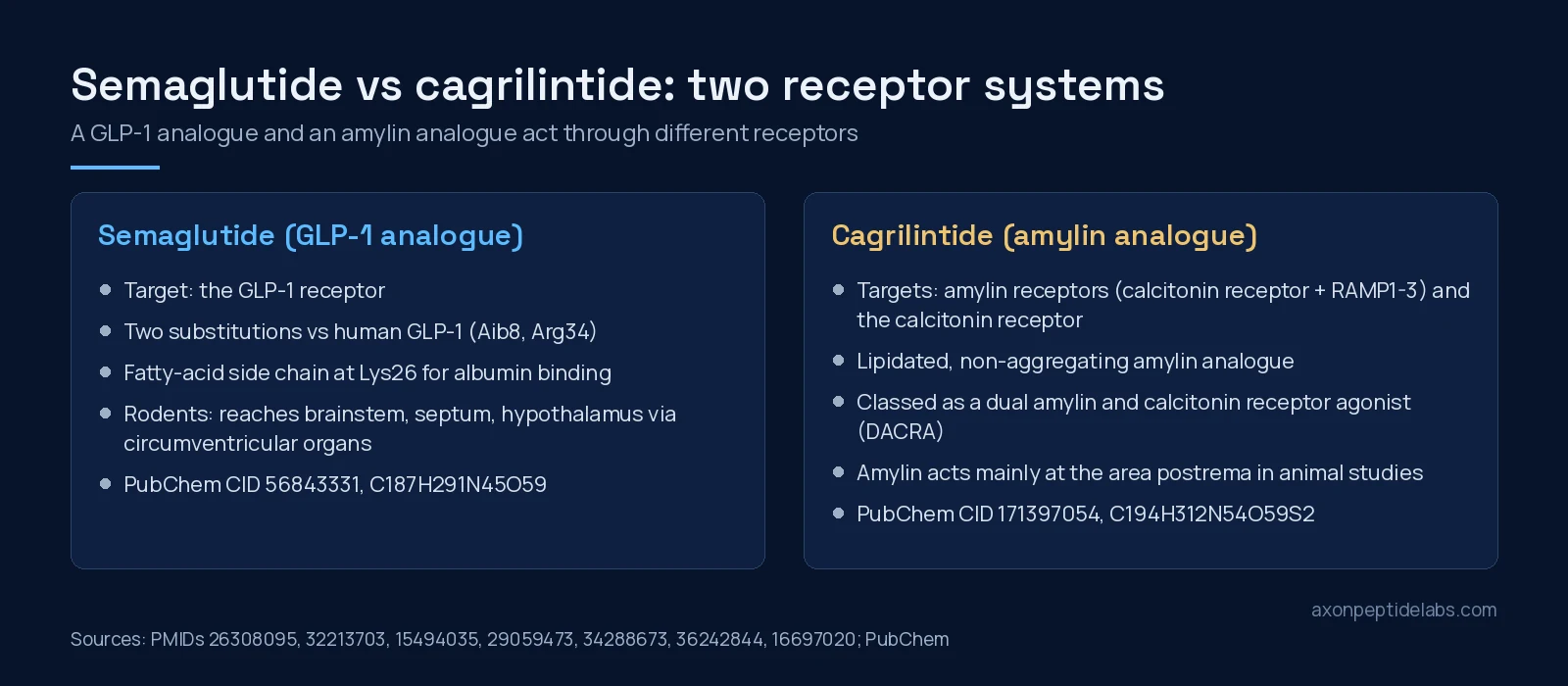
Short answer: semaglutide and cagrilintide are not competing versions of one drug class. Semaglutide is a long-acting analogue of GLP-1, a gut hormone, and acts at the GLP-1 receptor [1][2]. Cagrilintide is a long-acting analogue of amylin, a hormone co-secreted with insulin by pancreatic beta cells, and acts at amylin receptors (calcitonin receptor plus a RAMP accessory protein) and at the calcitonin receptor itself [3][4][5]. Because the two act through separate receptor systems, the main research question has been how they behave together, which is what the CagriSema trial programme tests. Semaglutide has FDA-labelled products; cagrilintide is investigational.
Identity at a glance
| Item | Semaglutide | Cagrilintide |
|---|---|---|
| Class | GLP-1 receptor agonist (acylated GLP-1 analogue) | Amylin analogue; dual amylin and calcitonin receptor agonist (DACRA) |
| Parent hormone | Human GLP-1 | Amylin (islet amyloid polypeptide, PubChem 16132430) |
| Key structural changes | Aib8 and Arg34 substitutions; Lys26 carries a fatty-acid side chain for albumin binding | Lipidated, non-aggregating amylin analogue |
| PubChem CID | 56843331 | 171397054 |
| Molecular formula | C187H291N45O59 | C194H312N54O59S2 |
| Molecular weight (PubChem) | 4114 | 4409 |
| CAS (PubChem synonyms) | 910463-68-2 | 1415456-99-3 |
| US regulatory status | FDA-labelled products (Ozempic, Wegovy, Rybelsus) | No FDA label or Drugs@FDA entry found (checked October 1, 2026); investigational |
Sources for the structural rows: [1][3][6]; formulas and CAS numbers are PubChem’s.
Semaglutide: how a GLP-1 analogue was made long-acting
Native GLP-1 is released from gut enteroendocrine cells, raises glucose-dependent insulin release, lowers glucagon, and slows gastric emptying and food intake [2]. Semaglutide was designed from liraglutide by increasing albumin affinity and blocking metabolic breakdown: it has two substitutions versus human GLP-1 (Aib at position 8 and Arg at 34) and a fatty-acid derivative on lysine 26 [1][7]. Its GLP-1 receptor affinity was about three-fold lower than liraglutide’s, while its albumin affinity was higher, and in mini-pigs its plasma half-life after intravenous administration was about 46 hours [1]. The trade-off is deliberate: slightly weaker binding, much longer exposure.
Where it acts in the brain has been mapped in rodents. Labelled semaglutide reached the brainstem, septal nucleus and hypothalamus but did not cross the blood-brain barrier; it entered through circumventricular organs and sites next to the ventricles, and it activated c-Fos in ten brain areas, including secondary regions with no direct GLP-1 receptor contact such as the lateral parabrachial nucleus [8]. In the same work, food intake fell without a fall in energy expenditure [8].
Cagrilintide: an amylin analogue built not to aggregate
Amylin is co-secreted with insulin. In laboratory animals it reduces food intake, slows gastric emptying and lowers post-meal glucagon, and these actions appear to depend on the area postrema in the hindbrain [9][10]. From there the signal is relayed through the nucleus of the solitary tract and the lateral parabrachial nucleus to the hypothalamus [10]. Note the overlap with semaglutide’s map: the lateral parabrachial nucleus appears in both [10][8].
The obstacle to amylin drugs is chemistry. Human amylin readily forms amyloid fibrils. The first approved analogue, pramlintide, borrowed residues from non-aggregating rat amylin but is short-acting [3][6]. Cagrilintide is a stable, lipidated, long-acting analogue developed for once-weekly clinical testing [3][11]. Pramlintide carries an FDA label as an adjunct to insulin (FDA label, NLM database); cagrilintide does not.
The receptor side is more complex than for GLP-1. Amylin receptors are heterodimers: the calcitonin receptor (CTR) paired with RAMP1, RAMP2 or RAMP3 gives AMY1, AMY2 and AMY3 [5][12]. Because CTR can also signal without a RAMP, and selective antagonists are scarce, assigning an in vivo effect to one receptor is hard [12]. Cagrilintide activates both amylin receptors and the calcitonin receptor in vitro and in vivo [4].
Why researchers combine them
The rationale is that the two hormones reach overlapping brain circuits through different receptors and entry points: amylin mainly via the area postrema [9][10], semaglutide via several circumventricular organs [8]. Two separate receptor systems can be engaged at once without competing for the same binding site. A 2026 review describes how the field has since moved on to single molecules that hit both systems, such as amycretin, a unimolecular amylin/calcitonin/GLP-1 receptor agonist, and to newer amylin analogues including eloralintide and petrelintide [6]. A second 2026 review traces amylin from its discovery in 1986 through pramlintide to these combination approaches [13]. For research purposes, this means semaglutide versus cagrilintide is less a contest than a comparison of two receptor families that are increasingly studied together.
Semaglutide vs cagrilintide side by side
| Feature | Semaglutide | Cagrilintide | Sources |
|---|---|---|---|
| Receptor(s) | GLP-1 receptor | AMY1-3 (CTR + RAMP1-3) and CTR | [2][5][4] |
| Native hormone source | Gut enteroendocrine cells | Pancreatic beta cells (with insulin) | [2][10] |
| How it was made long-acting | Albumin binding via fatty-acid side chain; Aib8 blocks breakdown | Lipidation; non-aggregating design | [1][3] |
| Main brain entry points (animal data) | Circumventricular organs; brainstem, hypothalamus | Area postrema, then NTS and lateral parabrachial nucleus | [8][9][10] |
| Shared effects studied | Gastric emptying, food intake, glucagon | Gastric emptying, food intake, glucagon | [2][9] |
| Most common adverse events in trials | Gastrointestinal, mostly mild to moderate (combination trials) | [14][15] | |
| US status | FDA-labelled products | Investigational | FDA labels (NLM); Drugs@FDA |
| Axon COA status | No certificate is posted for Semaglutide 10mg or Cagrilintide 5mg on our COA page at the time of writing | COA page | |
The clinical programmes, by design
We list design, population, comparator and primary endpoint only. Effect sizes are in the papers; we do not restate them, and nothing here is guidance on use.
| Trial (year) | Phase / length | Population | Arms | Primary endpoint |
|---|---|---|---|---|
| STEP 1 (2021) [16] | Double-blind RCT, 68 weeks | Adults with obesity or overweight with a coexisting condition, no diabetes | Semaglutide vs placebo, plus lifestyle intervention | Percent change in body weight; share reaching 5% or more |
| Cagrilintide phase 2 (2021) [11] | Phase 2 dose-finding, 26 weeks | Adults without diabetes, obesity or overweight with comorbidity; 57 sites in 10 countries including Canada | Five cagrilintide dose levels vs liraglutide vs placebo | Percent change in body weight at week 26 |
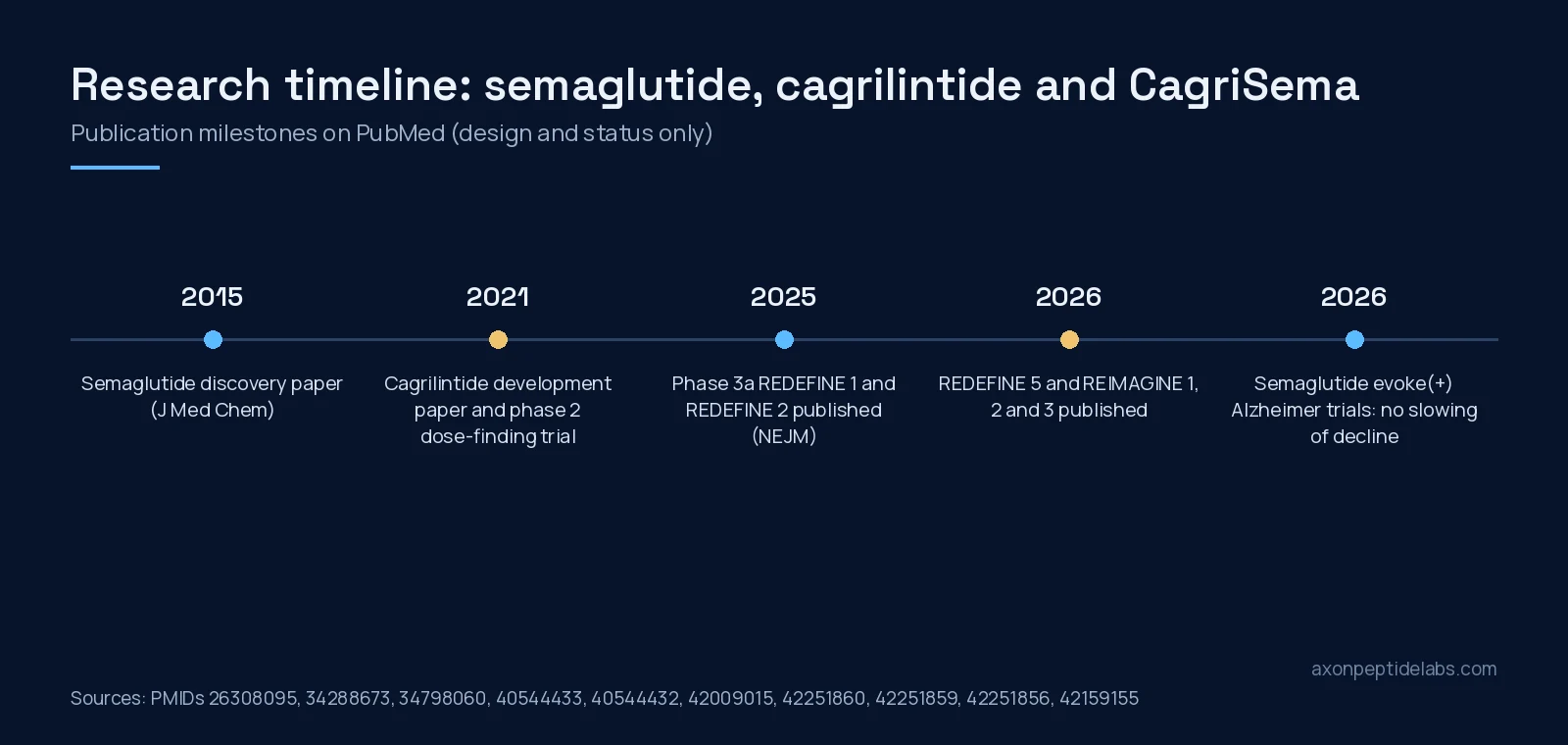
| REDEFINE 1 (2025) [14] | Phase 3a, 68 weeks | Adults without diabetes | CagriSema vs semaglutide vs cagrilintide vs placebo | Relative change in body weight; 5% or more reduction, vs placebo |
| REDEFINE 2 (2025) [17] | Phase 3a, 68 weeks | Adults with type 2 diabetes | CagriSema vs placebo | Percent change in body weight; 5% or more reduction |
| REDEFINE 5 (2026) [15] | Phase 3a, 68 weeks | Adults in Japan and Taiwan, with or without type 2 diabetes | CagriSema vs semaglutide | Relative change in body weight at week 68 |
| REIMAGINE 1 (2026) [18] | Phase 3a, 40 weeks | Early type 2 diabetes on diet and exercise | Two CagriSema dose levels vs placebo | Change in HbA1c at week 40 |
| REIMAGINE 2 (2026) [19] | Phase 3, 68 weeks | Type 2 diabetes on metformin with or without an SGLT2 inhibitor | CagriSema vs semaglutide vs cagrilintide vs placebo | Change in HbA1c, CagriSema vs semaglutide |
| REIMAGINE 3 (2026) [20] | Phase 3, 40 weeks | Type 2 diabetes on basal insulin | Two CagriSema dose levels vs placebo | Change in HbA1c at week 40 |
Two design points stand out. Only some trials include semaglutide alone or cagrilintide alone as an active arm (REDEFINE 1, REDEFINE 5, REIMAGINE 2), so only those can speak to what each component adds [14][15][19]. And each of the trial papers listed reports Novo Nordisk, the developer of both molecules, as funder [16][14][17][15].
Null and negative results worth knowing
- Semaglutide and early Alzheimer’s disease. The phase 3 evoke and evoke+ trials found that oral semaglutide did not slow cognitive or functional decline in early Alzheimer’s disease, despite supportive preclinical and observational data [21][22]. A 2026 review calls this a translational paradox: positive in models and cohort studies, negative in the randomised test [22].
- Receptor balance matters, and cagrilintide was not the strongest. In obese and diabetic rat models, a calcitonin-receptor-biased DACRA (KBP-336) outperformed cagrilintide on long-term body-weight and glucose measures [4]. Cagrilintide is one design point among several.
- No direct brain penetration. Semaglutide did not cross the blood-brain barrier in rodents; its central effects run through circumventricular organs [8].
What the evidence does not show
- That amylin and GLP-1 agonism are the same mechanism. The receptors, cell sources and receptor-assignment problems differ [5][12][2], even where downstream brain regions overlap [10][8].
- Anything about cagrilintide’s long-term safety outside sponsored trial populations. It has no FDA label, and the human data come from the trials listed above.
- That rodent brain maps transfer directly to people. The access and c-Fos findings are from rodents [8]; the area-postrema work for amylin is largely animal research [9].
- That research-grade material matches the trial products. Trials used manufacturer formulations. A research vial’s identity and purity can only be judged from its own analytical report.
Documentation for Axon’s semaglutide and cagrilintide listings
Axon lists Semaglutide 10mg and Cagrilintide 5mg among its metabolic research peptides. No certificate of analysis is posted for either on our COA page at the time of writing, so we make no purity or identity claim for them here. If a report is added, check that the measured mass matches the PubChem values above (about 4,114 Da for semaglutide, about 4,409 Da for cagrilintide). For the GLP-1 family more broadly, our semaglutide vs tirzepatide vs retatrutide comparison covers the incretin side.
When you buy lab-tested peptides in Canada, review each listing’s posted reports first.
Frequently asked questions
What is the difference between semaglutide and cagrilintide?
Semaglutide is a long-acting GLP-1 analogue that acts at the GLP-1 receptor. Cagrilintide is a long-acting amylin analogue that acts at amylin receptors (the calcitonin receptor paired with RAMP1, 2 or 3) and at the calcitonin receptor. They mimic two different hormones from two different organs.
What is CagriSema?
CagriSema is the name used in trials for cagrilintide and semaglutide given together on a weekly schedule. It has been tested in the phase 3 REDEFINE and REIMAGINE programmes in adults with obesity or type 2 diabetes. It is investigational.
Is cagrilintide approved?
We found no FDA label or Drugs@FDA entry for cagrilintide or CagriSema when we checked on October 1, 2026. Semaglutide is marketed in the US under FDA-labelled products, and pramlintide is the FDA-labelled amylin analogue.
Why is amylin hard to turn into a drug?
Human amylin readily forms amyloid fibrils. Pramlintide borrowed residues from non-aggregating rat amylin but is short-acting; cagrilintide was engineered as a stable, lipidated analogue with a long duration of action.
Did semaglutide work in Alzheimer’s disease trials?
No. The phase 3 evoke and evoke+ trials found that oral semaglutide did not slow cognitive or functional decline in early Alzheimer’s disease, despite supportive preclinical and observational data.
Does Axon post a COA for its semaglutide or cagrilintide?
Not at the time of writing. No certificate is posted for Semaglutide 10mg or Cagrilintide 5mg on the Axon COA page, so this article makes no purity or identity claim for either.
References
- Lau J, Bloch P, Schäffer L et al. (2015). Discovery of the Once-Weekly Glucagon-Like Peptide-1 (GLP-1) Analogue Semaglutide. J Med Chem. PMID: 26308095. doi: 10.1021/acs.jmedchem.5b00726.
- Drucker DJ (2018). Mechanisms of Action and Therapeutic Application of Glucagon-like Peptide-1. Cell Metab. PMID: 29617641. doi: 10.1016/j.cmet.2018.03.001.
- Kruse T, Hansen JL, Dahl K et al. (2021). Development of Cagrilintide, a Long-Acting Amylin Analogue. J Med Chem. PMID: 34288673. doi: 10.1021/acs.jmedchem.1c00565.
- Larsen AT, Mohamed KE, Sonne N et al. (2022). Does receptor balance matter? – Comparing the efficacies of the dual amylin and calcitonin receptor agonists cagrilintide and KBP-336 on metabolic parameters in preclinical models. Biomed Pharmacother. PMID: 36242844. doi: 10.1016/j.biopha.2022.113842.
- Hay DL, Christopoulos G, Christopoulos A et al. (2004). Amylin receptors: molecular composition and pharmacology. Biochem Soc Trans. PMID: 15494035. doi: 10.1042/BST0320865.
- Bailey CJ, Flatt PR, Conlon JM (2026). Long-acting amylin-related peptides as therapies for obesity and type 2 diabetes. Peptides. PMID: 41747885. doi: 10.1016/j.peptides.2026.171480.
- Knudsen LB, Lau J (2019). The Discovery and Development of Liraglutide and Semaglutide. Front Endocrinol (Lausanne). PMID: 31031702. doi: 10.3389/fendo.2019.00155.
- Gabery S, Salinas CG, Paulsen SJ et al. (2020). Semaglutide lowers body weight in rodents via distributed neural pathways. JCI Insight. PMID: 32213703. doi: 10.1172/jci.insight.133429.
- Lutz TA (2006). Amylinergic control of food intake. Physiol Behav. PMID: 16697020. doi: 10.1016/j.physbeh.2006.04.001.
- Lutz TA (2012). Control of energy homeostasis by amylin. Cell Mol Life Sci. PMID: 22193913. doi: 10.1007/s00018-011-0905-1.
- Lau DCW, Erichsen L, Francisco AM et al. (2021). Once-weekly cagrilintide for weight management in people with overweight and obesity: a multicentre, randomised, double-blind, placebo-controlled and active-controlled, dose-finding phase 2 trial. Lancet. PMID: 34798060. doi: 10.1016/S0140-6736(21)01751-7.
- Hay DL, Garelja ML, Poyner DR et al. (2018). Update on the pharmacology of calcitonin/CGRP family of peptides: IUPHAR Review 25. Br J Pharmacol. PMID: 29059473. doi: 10.1111/bph.14075.
- Secher A, Lutz TA, Raun K (2026). The story of amylin: from physiology to therapy. Nat Metab. PMID: 41708975. doi: 10.1038/s42255-026-01465-4.
- Garvey WT, Blüher M, Osorto Contreras CK et al. (2025). Coadministered Cagrilintide and Semaglutide in Adults with Overweight or Obesity. N Engl J Med. PMID: 40544433. doi: 10.1056/NEJMoa2502081.
- Yamauchi T, Becker NP, Hagemann CA et al. (2026). Efficacy and safety of co-administered cagrilintide and semaglutide versus semaglutide alone in adults with overweight or obesity with or without type 2 diabetes in Japan and Taiwan (REDEFINE 5): a multicentre, randomised, active-controlled, phase 3a trial. Lancet Diabetes Endocrinol. PMID: 42009015. doi: 10.1016/S2213-8587(25)00402-4.
- Wilding JPH, Batterham RL, Calanna S et al. (2021). Once-Weekly Semaglutide in Adults with Overweight or Obesity. N Engl J Med. PMID: 33567185. doi: 10.1056/NEJMoa2032183.
- Davies MJ, Bajaj HS, Broholm C et al. (2025). Cagrilintide-Semaglutide in Adults with Overweight or Obesity and Type 2 Diabetes. N Engl J Med. PMID: 40544432. doi: 10.1056/NEJMoa2502082.
- Aroda VR, Buzzetti R, Dalskov SM et al. (2026). Efficacy and safety of once-weekly cagrilintide-semaglutide (CagriSema) in adults with type 2 diabetes inadequately controlled on diet and exercise (REIMAGINE 1): a randomised, double-blind, placebo-controlled, phase 3a study. Lancet Diabetes Endocrinol. PMID: 42251860. doi: 10.1016/S2213-8587(26)00126-9.
- Buse JB, Bajaj HS, Dalskov SM et al. (2026). Cagrilintide-semaglutide (CagriSema) versus semaglutide or cagrilintide in people with type 2 diabetes (REIMAGINE 2): a double-blind, randomised, controlled, phase 3 study. Lancet Diabetes Endocrinol. PMID: 42251859. doi: 10.1016/S2213-8587(26)00125-7.
- Rosenstock J, Billings LK, Gajria R et al. (2026). Cagrilintide-semaglutide (CagriSema) as an add-on to basal insulin in adults with type 2 diabetes (REIMAGINE 3): a randomised, double-blind, placebo-controlled, multicentre, phase 3 study. Lancet. PMID: 42251856. doi: 10.1016/S0140-6736(26)01022-6.
- Cummings JL, Atri A, Sano M et al. (2026). Plain language summary: the evoke(+) studies of semaglutide for early Alzheimer’s disease. Neurodegener Dis Manag. PMID: 42159155. doi: 10.1080/17582024.2026.2666332.
- Alhowail AH, Al Mouslem AK, Almatrafi MA et al. (2026). Semaglutide in cognitive dysfunction: neuroprotective potential, clinical trial limitations, and a prevention-focused framework. Front Aging Neurosci. PMID: 42325226. doi: 10.3389/fnagi.2026.1851072.